

Inheriting a house is already different from selling a home you have lived in for years. When the property is packed with decades of belongings, the first challenge may not even be real estate.
You may need to figure out who has authority to enter the house, which belongings belong to the estate, what family members want to keep, whether important documents are hidden inside the clutter, and how much of the property can actually be seen.
Only after those questions are under control does it make sense to decide whether to clean, repair, list, or sell the house in its current condition.
For an inherited hoarder house in Knoxville, TN, a practical order is:
secure the estate → protect important contents → document what is accessible → understand ownership and property obligations → compare selling routes.
That sequence helps prevent irreversible cleanout mistakes and keeps you from spending estate money before you understand what the property actually needs.
Quick Answer: How Do You Sell an Inherited Hoarder House in Knoxville?
First, confirm who has authority to make decisions about the house and personal property. Secure valuable documents and belongings before cleanup begins. Then document accessible areas, check the deed, taxes, title, and property condition, and compare an as-is listing, prepared listing, and direct sale based on expected net proceeds and the work each requires.
For broader condition and selling guidance, see our complete guide to selling a hoarder house in Knoxville, TN. That page covers general hoarder properties; this guide focuses specifically on the complications created when the house is part of an inheritance.
Before Anything Leaves the House, Establish Control
Do not begin by asking:
“How many dumpsters do we need?”
Start with:
“Who is responsible for this property, and who is allowed to make decisions?”
Depending on the estate, ownership, and probate status, the relevant person may be an executor, administrator, trustee, surviving owner, beneficiary, heir, or another legally authorized party.
Gather whatever documents are available, including:
- The current deed
- Will or trust documents
- Death certificate
- Probate paperwork
- Mortgage statements
- Insurance information
- Property-tax records
- Utility information
- Keys and access codes
The Knox County Register of Deeds maintains recorded real estate documents in Knox County. Its records include deeds and other documents affecting real property, but recorded documents alone do not replace professional title or legal review when ownership is uncertain.
If the estate is already in probate or there is uncertainty about who can authorize a sale, use our more detailed guide to selling an inherited house during probate in Knoxville, TN rather than trying to solve the entire probate question through a cleanup decision.
Treat the House and Its Contents as Two Separate Problems
This is one of the most useful distinctions for an inherited hoarder property.
You are dealing with:
1. Real property — the land and house.
2. Personal property — furniture, papers, tools, jewelry, photographs, household items, collections, and everything else inside.
Families often try to decide both at the same time.
That creates confusion.
You might ultimately sell the house while keeping certain belongings. You might sell some estate items separately. You may donate or dispose of unwanted contents. Or the eventual buyer may agree to take responsibility for some remaining belongings.
Handle those decisions deliberately instead of assuming that “selling the house” means “throw away everything inside.”
Create an Estate-Property Inventory Before the Full Cleanout
You do not need to catalog every newspaper, plate, or old piece of clothing.
Focus first on items that could have legal, financial, sentimental, or meaningful resale value.
Take photographs of each room before major removal begins.
Then create a simple record showing:
- Items removed for safekeeping
- Items requested by particular heirs
- Documents found
- Valuable property identified
- Items sent for appraisal or sale
- Areas not yet reviewed
- Items approved for disposal
If several relatives are involved, store the photographs and inventory in a shared digital folder.
This creates a record of what was in the property before everything started moving.
Build a “Find First” List for Anyone Helping With Cleanup
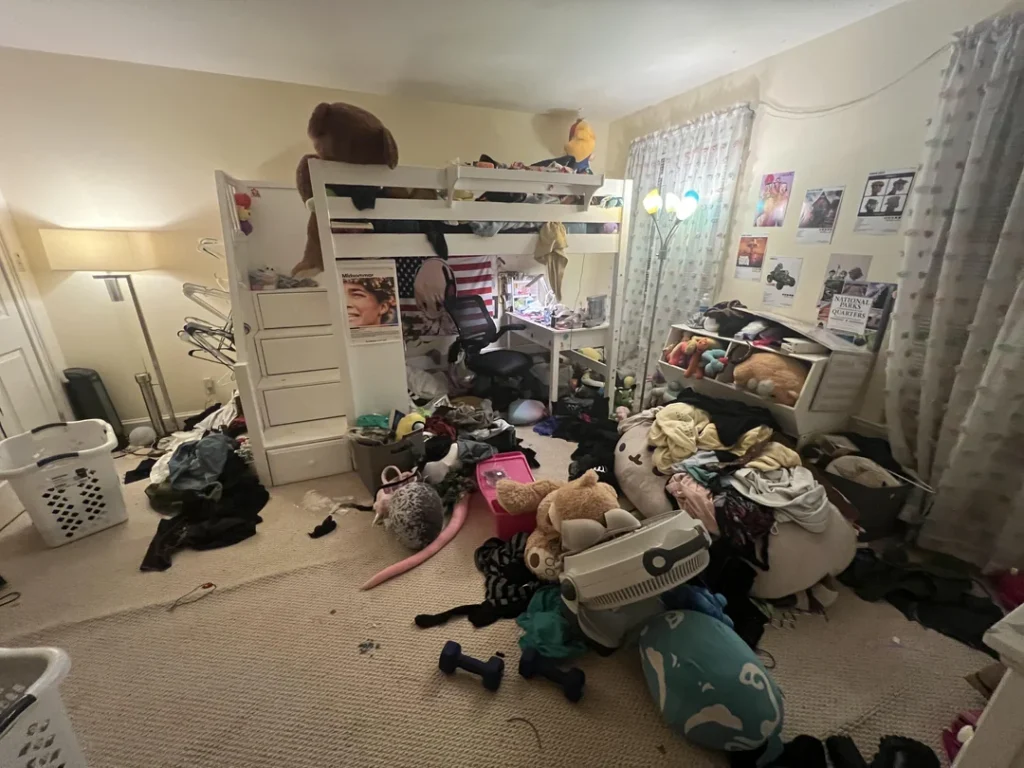
If a cleanup company, relative, friend, estate-sale professional, or other person will be working inside the home, give them instructions about what must not be discarded without review.
A useful find-first list includes:
- Wills
- Trust documents
- Deeds
- Tax paperwork
- Mortgage documents
- Bank statements
- Investment records
- Insurance policies
- Vehicle titles
- Keys
- Cash
- Jewelry
- Coins or collections
- Family photographs
- Military records
- Birth and marriage records
- Property repair invoices
- Contractor reports
- Sentimental items specifically identified by the family
This is different from deciding whether the whole property needs cleaning.
Our article on whether to clean a hoarder house before selling in Knoxville owns that broader cleanup decision and compares full cleanout, partial cleanup, and selling with contents remaining.
For the inherited property, the first priority is making sure something important is not permanently lost.
When Several Heirs Are Involved, Decide How Personal Property Will Be Handled
A dispute over the home itself is one problem.
A dispute over what is inside it is another.
One sibling may want an antique dresser. Another may want photographs. Someone else may believe a collection should be sold rather than divided.
Before approving widespread disposal, establish a process.
For example:
Keep — requested family or estate property.
Review — uncertain items that require another person’s decision.
Sell — property the authorized parties agree should be sold separately.
Donate/Dispose — belongings approved for removal.
Remain — contents that may stay with the house if the eventual purchase contract permits it.
If ownership of the real estate itself is divided among several heirs, our guide to selling an inherited house with multiple heirs in Knoxville addresses ownership interests, signatures, expenses, disagreements, and distribution in more depth.
Keep the new hoarder-house article focused on what makes the situation different: the estate contains a large amount of physical property that may need decisions before the real-estate transaction can move forward.
Map What You Can Actually Access
A heavily cluttered house should not be treated as though every part of it has already been inspected.
Create a simple accessibility map.
Accessible
Areas that can be entered and reasonably viewed.
Partially Accessible
Areas where some walls, flooring, systems, or fixtures are blocked.
Inaccessible
Rooms, crawlspaces, garages, closets, attics, or other areas that cannot yet be safely evaluated.
This is useful when speaking with:
- Real estate agents
- Contractors
- Inspectors
- Cleanout companies
- Potential buyers
- Title or closing professionals
Instead of saying:
“The house is in terrible condition.”
you can explain:
“These four rooms are accessible, this bedroom is only partially accessible, and the crawlspace entrance is currently blocked.”
That produces better information.
It also prevents everyone from assuming that an inaccessible area is either perfectly fine or severely damaged before anyone actually sees it.
Cleanup Can Reveal a Different House
Once belongings start leaving, the property’s condition may become clearer.
You might uncover:
- Damaged flooring
- Plumbing leaks
- Roof-related water staining
- Pest activity
- Broken windows
- Deteriorated subfloor
- Wall damage
- Electrical problems
- Crawlspace moisture
- Structural or settling concerns
- Mold or suspected microbial growth
- Deferred repairs hidden behind stored items
That does not mean every hoarder house contains severe hidden damage.
It means your first valuation should account for uncertainty when substantial parts of the house cannot be evaluated.
If cleanup reveals a material condition you previously did not know about, disclosure questions may also change. Address newly discovered information with the real estate or legal professional handling the sale rather than assuming the original understanding of the house still applies.
Check the Real Estate Before Spending Heavily on the Contents
An estate can spend thousands of dollars cleaning a house that still has unresolved property problems.
Before authorizing a large cleanup or renovation budget, check the financial and title picture.
The main questions are:
- Who owns the house?
- Is there a mortgage?
- Are there other recorded liens?
- Are the property taxes current?
- Does the estate have authority to sell?
- Are there ownership discrepancies?
- Will significant debts reduce the estate’s proceeds?
Use the Knox County Register of Deeds as a starting point for recorded property documents and the Knox County Trustee for county property-tax information. The Trustee’s office provides property-tax services and online payment resources for Knox County.
Professional title work should still be completed for the transaction.
Decide How Much Estate Money, If Any, Should Go Into the House
Once you know the contents situation and have enough access to understand the property better, decide whether additional cleanup or repair is likely to improve the estate’s financial outcome.
This is where many families overspend.
Do not automatically assume:
“If we spend $40,000, we will get $40,000 more when we sell.”
Instead, get three numbers.
The Three Numbers Heirs Need Before Choosing How to Sell
1. Current As-Is Market Estimate
Ask an experienced local agent what the house could realistically attract in its present condition.
Do not assume MLS exposure requires a full renovation.
2. Prepared or Repaired Net Estimate
Ask what the home could reasonably sell for after specific cleanup and repair work.
Then subtract:
- Cleanup
- Repairs
- Landscaping
- Utilities
- Insurance
- Property taxes
- Mortgage carrying costs
- Brokerage compensation
- Seller concessions
- Other transaction expenses
The important number is the expected net proceeds, not the repaired selling price.
3. Direct As-Is Offer
Obtain a written offer from a buyer willing to consider the property in its current condition.
Confirm:
- What belongings can remain
- Whether repairs are required
- Seller-paid costs
- Inspection or due-diligence rights
- Any circumstances that can change the price
- Proposed closing timeline
Now you are comparing three real strategies rather than guessing.
If the family already knows it does not want to renovate the property, see our dedicated guide to selling an inherited property as-is in Knoxville, TN.
What Can Stay in the House After It Is Sold?
This deserves more attention in an inherited hoarder-house article than it does in a normal inherited-property guide.
Sometimes the heirs remove only:
- Documents
- Valuables
- Sentimental property
- Items specifically requested by family
and leave unwanted furniture or household contents behind.
That can work only when the buyer agrees.
Do not rely on a verbal statement such as:
“Don’t worry about the stuff.”
The purchase agreement or related written documentation should make clear what is being removed and who becomes responsible for remaining contents after closing.
This avoids an unnecessary dispute over whether the seller was supposed to empty the property.
When the Executor or Heirs Live Outside Knoxville
An out-of-state family has an additional management problem.
Someone may need to:
- Secure doors and windows
- Check the property periodically
- Photograph changing conditions
- Collect important mail
- Maintain the lawn
- Coordinate contractors
- Provide access
- Meet cleanout crews
- Handle estate-sale appointments
- Obtain repair estimates
Choose one reliable local point of contact when possible.
Use a shared folder for:
- Photos
- Cleanup estimates
- Repair estimates
- Property records
- Tax information
- Offers
- Estate expenses
- Written family decisions
Do not give a cleanup company broad instructions to “remove everything” when heirs hundreds of miles away have not finished reviewing the contents.
Do Not Let the Hoarding Condition Distract You From Taxes
The amount of clutter inside the property has nothing to do with how inherited-property tax rules work.
Tennessee’s former inheritance tax is no longer imposed for people who died in 2016 or later, according to the Tennessee Department of Revenue.
Federal tax questions are separate.
The IRS’s current Publication 551 guidance on basis explains how basis is determined for different types of property. Its current inherited-property guidance notes that the basis of inherited property is generally connected with the property’s fair market value at the date of death, subject to exceptions and alternative valuation rules.
Keep records such as:
- Date-of-death valuation information
- Appraisals
- Estate documents
- Major property expenses
- Repair invoices
- Closing statements
A CPA or qualified tax professional should advise the estate or heirs about the actual tax consequences.
Example: An Executor Managing a North Knoxville Hoarder House
Consider a hypothetical executor who lives in North Carolina and is responsible for an older inherited house in North Knoxville.
The property belonged to an uncle who had accumulated belongings for many years.
The executor visits and finds:
- Two bedrooms that are difficult to enter
- A garage packed with boxes and equipment
- An inaccessible crawlspace entrance
- Stacks of financial papers mixed with ordinary mail
- Furniture the family may want
- Evidence of an old ceiling leak
- An HVAC system whose condition is unknown
Instead of hiring a full-house cleanout immediately, the executor starts by changing access arrangements and documenting every room.
A relative and the executor then locate important estate documents, family photographs, jewelry, keys, and several records related to previous property repairs.
Anything uncertain goes into a review area.
Next, the family creates an accessibility map.
The living room and kitchen are accessible. Two bedrooms are partially accessible. The crawlspace and part of the garage remain inaccessible.
The executor checks recorded property information and the current county tax status before committing estate funds to major work.
Only then does the family obtain:
- A limited cleanup estimate
- A full cleanout estimate
- Repair estimates for known problems
- An agent’s current as-is opinion
- An estimate of potential proceeds after preparation
- A direct as-is offer
The family now has enough information to make a real decision.
If a full cleanup and targeted repairs produce a clearly better expected net result, they can authorize the work.
If the financial difference is small and the executor would otherwise need to manage months of cleanup and renovation from another state, they can weigh an as-is route instead.
The point of the example is not that one option always wins.
It is that estate control and information come before property preparation.
Common Mistakes With an Inherited Hoarder House
Emptying the Property Before Important Estate Items Are Secured
Once a dumpster leaves, recovering an accidentally discarded deed, photograph, document, or valuable item may be impossible.
Treating Personal Property and Real Estate as One Decision
The family can decide what happens to the contents separately from deciding how the house itself will be sold.
Spending Estate Money Before Checking Ownership and Property Obligations
A major cleanup does not solve title, tax, mortgage, or authority problems.
Repeating the Same Cleanup Analysis Forever
You eventually need enough information to make a decision—not perfect knowledge of every inch of the property.
Assuming Inaccessible Means Damaged
An area nobody can see represents uncertainty, not automatic failure.
Assuming Inaccessible Means Fine
The opposite assumption is just as weak.
Letting Several Heirs Give Different Instructions to Contractors
Designate an authorized contact so cleaners and contractors are not receiving contradictory directions.
Comparing Gross Prices Instead of Net Results
A repaired listing price, as-is MLS estimate, and direct offer all involve different costs and amounts of work.
Compare what the estate is likely to keep.
FAQs About Selling an Inherited Hoarder House in Knoxville, TN
1. Can I sell an inherited hoarder house in Knoxville without cleaning it out?
Yes, depending on the buyer and purchase agreement. Some buyers may accept unwanted furniture, boxes, and other contents with the property. Remove important documents, valuables, photographs, medications, and anything the estate or heirs want to keep first.
2. What should I remove first from an inherited hoarder house?
Start with wills, deeds, financial records, keys, cash, jewelry, photographs, collectibles, sentimental belongings, and items specifically requested by heirs. Review uncertain items before authorizing large-scale disposal.
3. Who can authorize the sale of an inherited hoarder house in Tennessee?
That depends on the deed, will, trust, probate status, ownership, and estate administration. An executor, administrator, trustee, heir, or other authorized person may be involved. Confirm legal authority before signing a sales contract.
4. What if several heirs disagree about the belongings in the house?
Create an inventory and separate items into keep, review, sell, donate/dispose, and potentially leave-with-house categories. Resolve major disagreements before belongings are permanently removed or sold.
5. Do I have to repair an inherited hoarder house before selling it in Knoxville?
No. Repairs are optional unless required by your chosen selling strategy or contract. Compare the property’s as-is value with realistic repaired net proceeds before spending estate money on renovations.
6. Can I list an inherited hoarder house as-is with a real estate agent?
Yes. A real estate agent can market an inherited property as-is. However, clutter, accessibility, repairs, inspections, financing, and buyer expectations may affect the price and buyer pool.
7. Can belongings stay inside an inherited house after closing?
Yes, if the buyer agrees. The purchase agreement should clearly state which belongings may remain and who becomes responsible for them after closing.
8. Can I sell an inherited hoarder house in Knoxville if I live out of state?
Yes, much of the process can often be coordinated remotely. A reliable local contact can help with access, photographs, belongings, maintenance, cleanup estimates, and inspections while the closing professional handles document requirements.
Secure the Estate Before Deciding How to Sell
An inherited hoarder house becomes easier to manage when you stop treating it as one giant cleanup project.
Handle the estate problem first:
Establish control.
Protect important property.
Document what can and cannot be evaluated.
Check ownership, taxes, and title.
Then decide whether cleanup or repairs are financially worthwhile.
If preparing and listing the property is likely to leave the estate materially better off and the family can manage the work, that route deserves serious consideration.
If extensive belongings and repairs make preparation impractical, Knox Home Buyers can review the house in its current condition and provide a local cash offer for comparison.
A direct offer should be another option—not a reason to ignore a stronger alternative.
You can review how Knox Home Buyers purchases houses or contact Knox Home Buyers when you are ready to discuss the property.
Important Disclaimer: This article provides general educational information only and is not legal, probate, tax, financial, or title advice. Authority to manage or sell inherited property depends on the deed, will, trust, probate proceedings, ownership interests, estate administration, debts, and individual circumstances. Consult a qualified Tennessee probate or real estate attorney, tax professional, and title or closing professional when appropriate.